
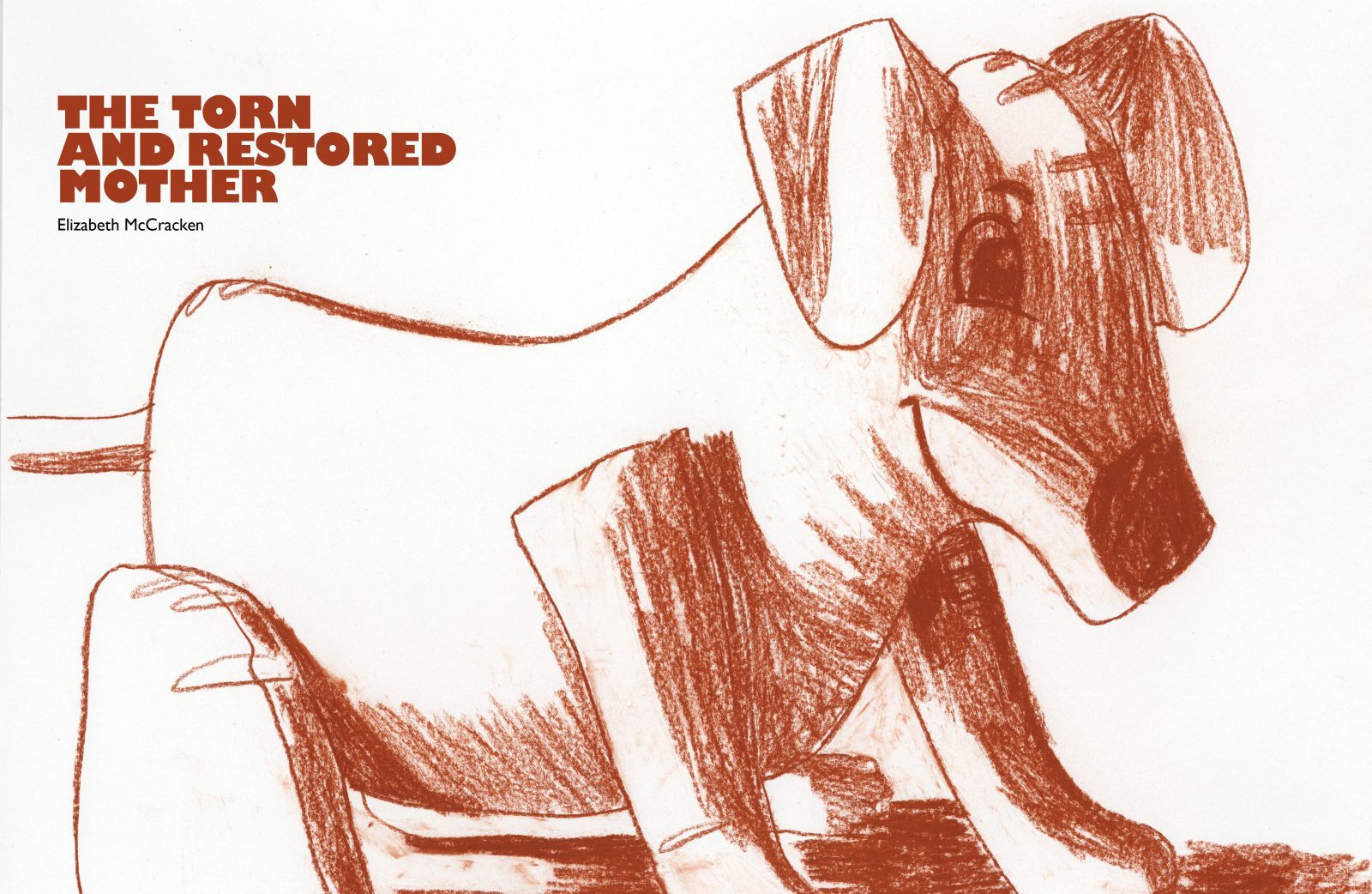
In the middle of October, 1972, our mother left. “Finally,” said our bald-headed, bull-shouldered father. We couldn’t tell whether finally meant she’d been planning or he’d been hoping. She left the house with all its windows, china cabinets, kitchen cupboards, French doors. She left Albert the beagle, full of woe and joy; Pan the striped cat; the three of us, ages nine through fourteen. She left all of Halloween, her favorite holiday, her wigs and dirndls, her false mustaches, the papier-mâché Statue of Liberty torch that resembled a caveman’s club: she wasn’t good at props. She left a half-constructed Henry VIII costume, meant for an eleven-year-old girl. More common than you might think, small girls fixated on Henry VIII, and our mother was indulgent, thought, It’s the wives, their dresses, his own pearled, plumed hat, but she was wrong: it was how he did away with his enemies.
Our mother was a show-off who liked to disappear, and though she made our frilled pirate shirts and itchy bear pelts on her pale-blue, excitable sewing machine, what really mattered were her own costumes. At rest, she was an ordinary-looking woman, with lank, blond hair she wore tacked to the back of her head, grayish-blue eyes, and a very ordinary mother’s body that was neither fat nor thin. In motion, her oddness emerged. The gap between her teeth, the thick wrists she tried to hide with bangles, a tendency to galumph up stairs and over curbs.
This year, she hadn’t chosen a costume. She just was gone.
We were young then. Later, we would never think of ourselves as an entity that might speak with one voice. We weren’t people who could feel or think together. But now, this October, abandoned by our mother, we just about managed it.
“Check in the trunk,” our father said.
“The what?”
“The trunk. The trunk. The trunk. Where your mother keeps the costumes.”
“Oh, the wardrobe,” said Victoria. Our father gave her a dirty look. But everything in our house, every room and object, had a name. The Wardrobe was in the Pink Room—though the room had been pink for only six months, a sickly, memorable color chosen by the previous owners, which we’d painted over. Just the implication of pink, our need to mock it, remained. Here, our mother kept her sewing machine and an old wardrobe, the largest piece of furniture we owned, three compartments with mirrored doors and a big drawer at the bottom. There was something funereal about it. Mausoleumesque. The lock was made of two parts, a little brass box with an oval knob that worked a latch, and a little brass box opposite that accepted the latch.
As we stood in front of it now, we wondered whether she’d hidden inside. Had got stuck. We didn’t want to open it and see. We hadn’t meant to ask our father to help with our costumes, only to point out another thing that seemed impossible without our mother. “There’s got to be something in there,” he said.
Our mother had filled all three compartments with old, bright dresses she no longer cared for, which she encouraged us to wear or cut up or put to peculiar, childish use. Of a certain miniskirt, she said, “This is Marimekko,” a word that made no sense and frightened us. Everything in the wardrobe frightened us. A threadbare fox stole with an intact head biting its own tail, a round, blue, nest-like hat of dyed feathers. A wedding dress she’d found at a yard sale, not antique silk but recent polyester, stiff, with a fingertip veil.
The only living thing inside the wardrobe was Pan the cat, napping in the bottom drawer, cozied up to the fox stole, which we didn’t think spoke well of him: he was either stupid or cruel.
“Be a cat,” our father suggested.
We didn’t want to be cats.
“Tramps?”
But we weren’t that sort of family. We had imaginations, or so we’d been told.
“Bride?” he said. “Vickie? One of you boys could wear my old tux. Or half man, half woman. The bad and the beautiful. Your mother was that.”
Was she?
“Split down the middle.” Our father indicated his own bodily axis. “This side coat and pants, this side a dress. Half a mustache. Makeup on the right. High school. Probably have pictures. You could do it, Vick.”
“I don’t want to be—”
“I’ll do it.”
“I was thinking one of the older two,” our father said to Porter. “What’s your teacher going to say when you show up in half a dress? Are you even allowed makeup?”
“Boys can wear makeup.”
“Very aware. But in fourth grade?”
“Sure. Why not?”
“Why not, why not,” said our father. “Knock yourself out. How about you, sweetheart? Henry VIII?”
“Costume’s not finished. I’ll be a dog.”
“Not a cat? All right. And you—you’re too old for Halloween.”
“I’m not,” said Morris.
“Aren’t you in high school?”
“Junior high. I’ll take them around. Might as well dress up.”
“I want to go to the haunted house at school,” said Porter.
“Be a tramp,” our father said again. “How are you going to make the ears?”
“What ears?”
“Not you, her. Dog ears. You could take a pair of brown socks, glue them to a headband. Be a spaniel.”
A good idea. It stunned us. We might do without our mother after all.
“I want a head,” said Vickie. “A whole dog head. Not just ears. I’ll make it,” she said, to herself.
“I need a top hat,” said Porter. “One I can cut in half.”
“We don’t have a top hat,” said our father, but how would he know?
What we wanted were the costumes sold at Woolworth’s, soft plastic coveralls, stiff plastic masks like shields. Inside the mask, a smell medicinal and furtive, factory and lung. We wanted the elastic cord to tangle in our hair; we wanted our faces walled off. Ungrateful children. Didn’t we know that our mother’s handmade costumes were proof of her love? Yes. To put on store-bought costumes would show how wretched we were without her. Loveless children, wrapped in plastic.
In fourth grade, all the girls drew the heads of dogs the same way: Two circles for the snout, then a series of horseshoe hoops. Nose; eyes made of little hoops, iris, pupil, socket; hoop of head; upside-down hoop of tongue. Lastly, you put in dots and lines for whiskers, curly brackets for ears. The result was phenomenally ugly, troublesome. Once you got to fifth grade, you realized there was something testicular about the snout. It was amazing what seemed testicular by fifth grade. Still, the process was step-by-step, and what you saw in your mind’s eye at the start was exactly what your hand delivered.
This turned out to be impossible to replicate in papier-mâché. Victoria sat at the kitchen table, its captain’s chairs brown and each with a handle cut out at the back, her hands black with ink and stiff with dried slurry. She was running out of newspaper. Our mother could roll a newspaper tight and cut it into strips at the top and pull it into a fringed tower. “Bamboo,” she’d say, and we believed her.
“Halloween’s tomorrow, Vick,” said Morris.
“I know.”
“You have to be something.”
“I can be nothing.”
Porter, nine, the only real child among us, said, “Of course you can’t be nothing.”
Our father’s old tux was a dull thing, no tails, just a satin-lapeled, dark-wool suit that smelled of cigarettes and distant dry-cleaning, little ghosts of Kleenex haunting the pockets. Morris figured out how to do it: fold the jacket in two and tuck one arm into the other, safety-pin it down the back to a white shirt, which would do for a blouse. He stepped a leg into a skirt of our mother’s with a side zip. Half a mouth of lipstick. An eye of mascara. All things left by our mother. In the pink room, he modeled for us.
“You stole my idea,” said Porter.
“It wasn’t your idea. It was Mom’s.”
We hadn’t spoken of her. Now we looked in the mirrored doors of the wardrobe. Three mirrors, three children, Morris in the middle, his lipstick the color of pantyhose, his cut-in-half wig worse than Victoria’s papier-mâché head. Nothing he’d done had conjured her up.
“I was going to be that,” said Porter.
“You’ll make a beautiful bride,” Morris replied, in that way he had, condescending, insulting, accurate.
Missing people was different in those days. They were only their absence, not their multifaceted failure to get in touch. Our mother could have called, but long distance was expensive, and perhaps she was on a train, or a ship, or staying with a stingy friend. After a week, she sent a postcard addressed to all of us. The Harkins. We recognized her handwriting instantly. The zoo here is low on monkeys, she wrote. Someday we’ll all come together. Love. Chicago, the round postmark told us, where our grandmother lived, our mother’s mysterious, fastidious own mother, a school librarian who’d been widowed as long as we’d known her. So our mother had gone home, then visited the zoo to escape, since our grandmother did not like zoos, or monkeys. The first reminded her of prisons; the second, of evolution, which she believed in but gave her the willies.
Our mother was missing. Hard to believe she wasn’t hiding in the house, ready for revenge. Unlike us, she didn’t mind the dark. Liked it, in fact. Hated overhead fixtures, with their milk-glass shades, the shadow puppetry of dead insects. Our father was always walking into rooms where she was reading in the strained light of window screens. “You’ll damage your eyes,” he’d say, flipping the switch. In the evenings, he’d draw all the curtains, turn on every lamp with a religious precision, then go to bed early, leaving her to douse everything.
Our father, in our mother’s absence, drank. Not more, or meanly, but out in the open. The umbrella of her disapproval had been removed, and he let his bad habits rain down upon the household. He smoked Newports through a window of the pink room, through a little exhaust fan. Nights, he sent us down to the House of Pizza for grinders, wrapped tight in wax paper and slid into bags. He trusted us. That was another of his bad habits. Even now, we can’t always tell the difference between trust and neglect, between love and surveillance.
He was a man who could change sizes, could turn himself on and off. Sometimes we couldn’t find him at all. We were orphans then, in the house. We ate canned food cold, straight from the can: Beefaroni, Spaghettios. Raviolios, which suctioned to each other like sea creatures, resisting our forks.
Our family wasn’t poor, just careless with money and frightened of the future; we had friends who were poor, and could tell the difference. We were broke. In those days, we were well-behaved children. At least, we played at goodness. We were thieves, only one of us—Morris—with honor. Porter would regularly shoplift from Woolworth’s, and Victoria pilfered all the quarters from the jug of coins by the sink. Ordinarily, she bought junk food from Coffey’s Market, clenching a fistful of orange cheese popcorn and gnawing at the face of it as though it were an apple.
Now she prowled the costume aisle of Woolworth’s. Not much left, cardboard boxes with cellophane windows, masks pressed up against. Batman, that mask like a cathedral with two towers, Batman stamped across the forehead.
She procured it with the stolen quarters. At home, she put on the mask, and all at once she was inside. Inside the mask and herself. Private, not because she was hidden, but because a door had been shut and she was alone, tucked into bed while her body kept walking. Forehead, nose, the round of her chin. Slot to breathe through, slits to look out. Before this, had she been split down the middle, it would have been Porter to the left and Morris to the right, no Victoria at all, always aware of where they were. Cut in half and made of brothers. Since Morris had moved on to the junior high, at school her right side was always cold.
She took off the mask and felt exposed, put on the mask and returned. The slits could match up to no actual human eyes. The slot was insufficient. To be shut up meant something.
Mask down. Me. Hot breath filling the closed atmosphere. Mother gone. My mother gone. Everyone else’s mother, too, but inside the mask: mine.
Had we been good kids, the three of us, before our mother left? No, but she would have forgiven us.
A haunted house, we had thought, meant an old, rundown Victorian with ghosts, the sighing of wind through windows, teachers with the singsong accents of artificial ghouls, a hint of I vunt to trink your blahd, bowls of peeled grapes, bowls of cold cooked spaghetti. We hadn’t imagined the pitch black in our elementary school, the fans blowing gusts of the dead. We hadn’t foreseen the durable medical goods: the ruched, wheeled ward dividers and the gurney, upon which
lay—
“Look.”
“Where.”
“Look.”
“I can’t see anything.”
“Put up your mask, Vick.”
Upon the gurney lay our father.
We thought he was dead, then drunk, then lost. All three. Why else would he be asleep in the cafeteria? To see a parent at school in those days was rare and wrong. To see a father, anyhow. We had room mothers, but they were always the same room mothers, never ours, women who came in to scream at fresh children they hadn’t broken yet. There was no picking up and dropping off. No appearing at lunchtime. In a finer, fancier public school, parents might have ridden on buses for field trips, but this was an unambitious school, named for two forgotten historical figures joined with a hyphen, neither distinguished enough to warrant an entire school in his honor, and here we were in the cafeteria, and there was our father laid out on a gurney.
“How did he get here?”
“I don’t know.”
To avoid him, we’d have to back away, but we could hear other kids behind us. We looked up to remind ourselves that we were in the new cafeteria, where on Fridays we were served square pizza, the highlight of the week for some. Hot lunch had just come in; the year before, we’d been on the cold-lunch program, delivered to our classrooms in brown paper bags, distinct from the lunch boxes other children carried. Baloney sandwiches, olive loaf: cold cuts. A kind of horror story. We could still smell the baloney, the damp ham. Even now we smell it. Our father ate liverwurst spread from a can; the can came wrapped in white paper, like a present; the white paper featured a little dancing red devil; our father lay on a gurney in the new cafeteria.
If the worst thing that happened to you is you had to eat cold baloney, you’re probably OK, our mother would tell us.
Could we smuggle him to the parking lot without people noticing? He groaned. He groaned. He groaned. He sat up, slowly, as though regaining consciousness. Blood trickled from his mouth. A surgical scar cleaved his forehead. Fake. He was there, of course, to scare everyone who came through the haunted house, not just us. A younger, thinner father might have snapped up at the waist or leapt from the gurney. Our father struggled. The reason he struggled was that he was wearing a straightjacket. Squinted. Said, “Did you cut my tux in half, you little asshole?”
Two things happened, only one of which could have been predicted. Victoria jumped back and split her Batman suit. Morris, fourteen-year-old Morris, burst into tears.
Poor Morris. Of all of us, he was closest to our mother. How could it be otherwise? A kid behind said in a small voice, “I’m ascared,” the way we all did in those days in our neighborhood, some of us serious and the rest of us making fun.
“I’m sorry,” said our father. “I wanted to surprise you. I’m so sorry.”
That he was here. That he was apologizing. That’s what frightened us.
Victoria pulled down the mask back over her face. She couldn’t explain why she hadn’t worn underpants that day. It wasn’t that, without our mother, the laundry piled up; we all did our own laundry. It was something darker in her, secretive, perverse. To neglect herself was a pleasure. The cape was too short.
Our father was still apologizing, not to Morris, but to some volunteer mother who’d heard him say asshole and walked in from the exit, holding her bowl of peeled grapes. She wore a nurse’s cape and a plaid minidress. And then Morris—one eye running mascara, above his lip a felt half mustache tinseled with snot—looked at Porter and Victoria. Our mother was gone: that was why he’d burst into tears. Not because he missed her, but because he understood that his life would be different. When fathers died at war in movies, the neighbors would tell the oldest son, You’re the man of the house now. What did that make Morris? What did it make Vickie? Milk through the nose, vomit on the teacher, an ability and willingness to flip your eyelids inside out, the girl who liked to blunder into the boys’ room, the boy whose eyebrows were shaved off by his father as punishment: Victoria would become one of these.
Morris dried his half mustache. Reached around to unpin the jacket from its blouse. Unfolded it, one arm out of the other, a magic trick. In the way of mothers, without being asked, without any way of even knowing, he handed it to Victoria to cover herself.
Who’s telling this story?
Guess.
It has to be one of you, or two of you. It could never be all of you. Morris then, who knew the most, or Porter, who knew the least, or Victoria. It has to be Victoria.
Be quiet. It’s not.
“I didn’t leave you,” our mother said to us when she returned a week later. “Grandma was sick.” She wore her ordinary clothes, a navy knit dress with brass buttons, along with an expression we’d never seen on her face: Astonishment, fear. Incomprehension. Respect, our father might have thought, though we knew better. “Dennis, what story did you tell?”
“You said not to worry them,” he said.
But it was too late to believe anything else, and we hung back, wary. Wary a long time.